Lenovo Qira AI: Is This the Future of Personal AI PCs?
 By Inflix
 Lenovo Qira AI could become one of the most important personal computing ideas of 2026. Instead of treating AI as a separate app, Lenovo wants Qira to work quietly across PCs, phones and tablets as a built-in intelligence layer.
This is important because users now move between multiple devices every day. A person may start work on a laptop, check messages on a phone, attend a meeting on a tablet and later return to the PC. Qira is designed to make that experience feel more connected.
For Mobile Verse readers, this topic matters because personal AI is not only coming to smartphones. It is also becoming part of laptops, tablets and wider device ecosystems.
What Is Lenovo Qira AI?
Lenovo Qira AI is a personal ambient intelligence system designed to work across Lenovo and Motorola devices. It is not meant to feel like a normal app that users open and close. Instead, Qira is built to stay available across devices and help users with context-aware support.
Lenovo says Qira can move with users, learn from them and help them get things done across Lenovo and Motorola devices. The idea is to make AI feel more like a continuous assistant than a single chatbot.
For official details, Lenovo has shared more about Lenovo Qira AI, including how it is designed to work across PCs, Motorola phones and other Lenovo devices.
Why Lenovo Qira AI Matters
Lenovo Qira AI matters because it shows how PC brands are changing their AI strategy. Instead of only adding faster chips or basic assistant shortcuts, Lenovo is trying to build a deeper cross-device AI experience.
This could be important for users who own multiple Lenovo or Motorola devices. Qira may help connect tasks, reminders, notifications, emails and meetings across the ecosystem.
The bigger idea is simple: AI should not be trapped inside one app. It should understand what users are doing across devices and help them continue tasks more smoothly.
Personal Ambient Intelligence Explained
Lenovo describes Qira as personal ambient intelligence. This means the AI is designed to be available in the background, understand context and assist without forcing users to constantly open a separate tool.
That is different from a basic chatbot. A chatbot usually waits for prompts. Ambient AI tries to understand the user’s situation and offer help at the right time.
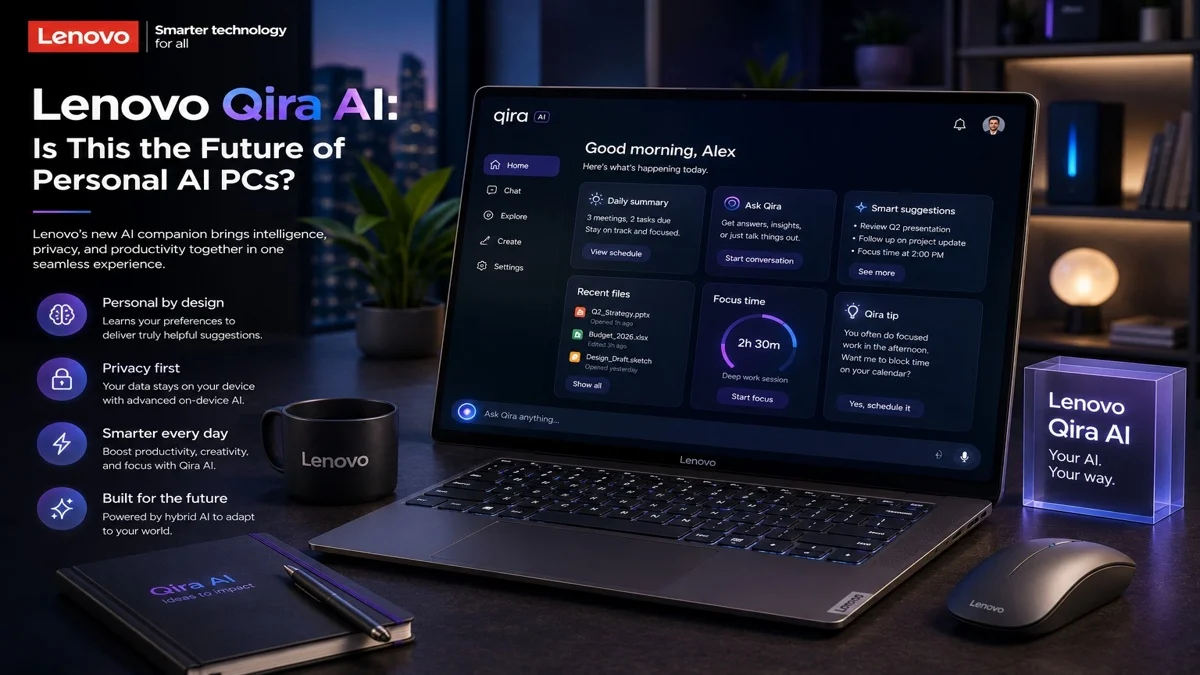
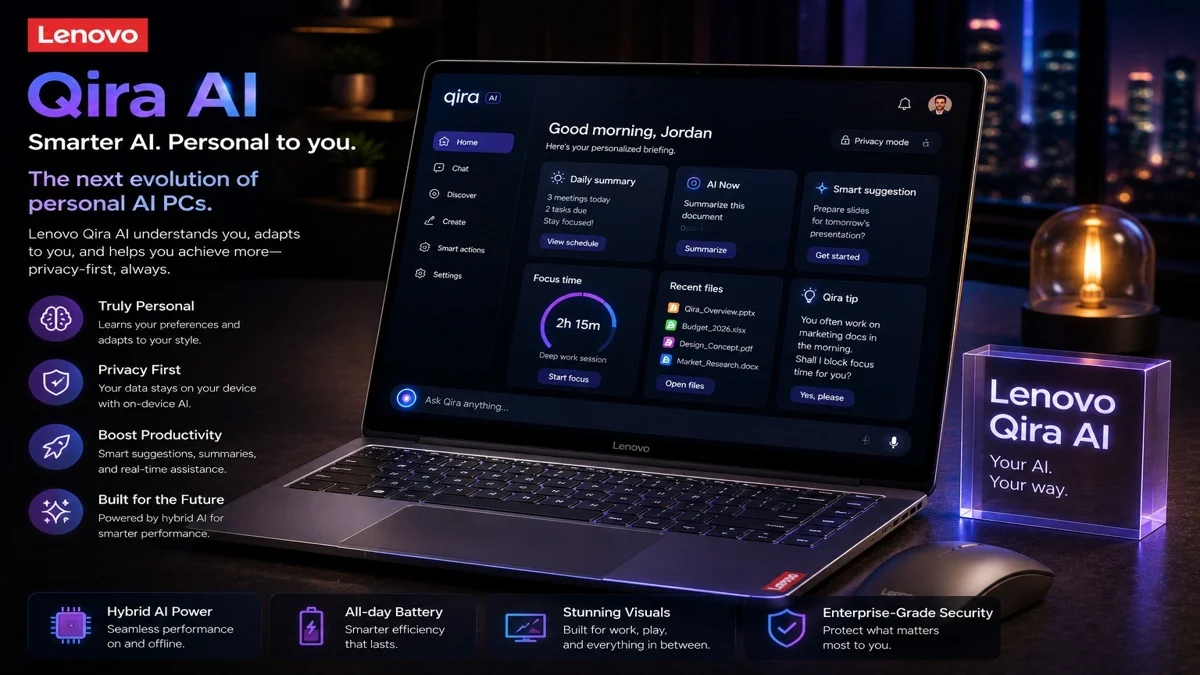
For example, Qira may help with emails, calendar entries, meetings, missed notifications and productivity tasks. Lifewire reports that Qira includes a “Catch Me Up” feature that can summarise missed notifications and help users get back on track.
Lenovo Qira AI Across PCs, Phones and Tablets
One of the strongest parts of Lenovo Qira AI is cross-device support. Lenovo wants Qira to work across PCs, Motorola smartphones, tablets and possibly more devices over time.
This is important because people do not use only one device anymore. They may start a task on a laptop, continue on a phone and finish later on another screen.
A cross-device AI assistant could reduce friction by remembering context and helping users move between devices. That could make Lenovo’s ecosystem feel more connected and competitive.
How Lenovo Qira AI Could Help Productivity
Productivity may be the biggest use case for Qira. Many users spend their day switching between emails, calendars, documents, meetings, chats and notifications.
Qira could help by summarising missed updates, finding important information, managing reminders and assisting with meeting details. This could reduce the time users spend searching manually.
For workers, students and business users, that kind of support could be valuable if it feels accurate and easy to trust.
Catch Me Up Could Be a Key Feature
Catch Me Up may become one of the most practical Qira features. The idea is simple: if users miss notifications, updates or messages, Qira can help summarise what matters.
This is useful because modern devices create too many alerts. Users often return to their laptop or phone and see a long list of notifications without knowing what is important.
A smart summary feature could help users focus faster. However, it must be accurate because missing an important message or summarising it incorrectly could cause problems.
Lenovo Qira AI and Motorola Phones
Lenovo owns Motorola, so Qira’s connection with Motorola phones is important. It means Lenovo is not only building AI for laptops. It is also trying to connect mobile and PC experiences more closely.
This could help Motorola phones stand out in a crowded Android market. If Qira works well across Motorola phones and Lenovo PCs, users may get an ecosystem benefit similar to what Apple users experience across iPhone and Mac.
For Motorola, this could be a major advantage if the experience feels smooth and reliable.
Lenovo Qira AI vs Microsoft Copilot
Lenovo Qira AI will naturally be compared with Microsoft Copilot. Copilot is already built into Windows and Microsoft 365, making it a strong productivity assistant for many PC users.
However, Qira appears to focus more on Lenovo’s own device ecosystem and cross-device continuity. That could make it useful for people using Lenovo PCs with Motorola phones.
The challenge is clear. Qira must offer enough value beyond Copilot, Gemini and other assistants. If it only repeats features users already have, it may not stand out.
Lenovo Qira AI vs Google Gemini
Google Gemini is becoming a major AI assistant across Android, Search and Google apps. Lenovo Qira AI is different because it is more focused on Lenovo and Motorola hardware integration.
Gemini may be stronger for search, knowledge and Android services. Qira may be stronger for device continuity, local workflows and Lenovo ecosystem support.
For users, the best experience may come when assistants work together rather than compete. Lenovo has reportedly designed Qira to integrate with third-party tools and AI services, which could make it more flexible.
How Qira Fits With AI Phones 2026
Lenovo Qira AI also connects with the wider AI phone trend. Smartphones are becoming personal assistants with better search, translation, camera tools and security features.
Qira adds another layer by connecting phones with PCs and tablets. This could make AI feel less like a phone-only feature and more like a full personal computing system.
You can read our Mobile Verse post on AI phones 2026 to see how smartphones are becoming smarter assistants.
Lenovo Qira AI and AI PCs
AI PCs are becoming a major topic in 2026. New laptops and desktops are adding stronger neural processing units, local AI features and productivity assistants.
Qira fits perfectly into this shift because it gives Lenovo a software experience to match AI PC hardware. Faster chips are useful, but users also need meaningful AI features.
You can also read our post on Nvidia RTX Spark AI laptops and mobile devices to understand how AI hardware is changing laptops and portable computing.
Why Ambient AI Could Replace App Switching
One of the most interesting ideas behind Qira is reducing app switching. Today, users move between email, calendar, browser, notes, chat apps and productivity tools.
Ambient AI could change that by understanding the task and helping across apps. Instead of searching manually, users may ask Qira to find information, summarise updates or continue a task.
This does not mean apps will disappear. However, AI could become a layer above apps that helps users move faster.
Lenovo Qira AI and Third-Party Apps
Reports suggest Qira can work with third-party tools such as Notion, Perplexity and Stability AI. This is important because users do not want an assistant that only works inside one company’s apps.
If Qira connects with popular productivity and creativity tools, it could become more useful for real workflows.
However, app integration also creates privacy and permission questions. Users should know what data Qira can access and how that information is handled.
Privacy Questions Around Lenovo Qira AI
Privacy will be a major issue for any ambient AI system. Qira may need access to notifications, calendars, emails, meetings, documents and device context to be useful.
That creates an important question: how much personal information should an AI assistant see?
Lenovo says Qira is designed with user consent and control in mind. Still, users should carefully review privacy settings, permissions and data-sharing options before enabling deep AI features.
On-Device AI and Cloud AI
Qira may use a mix of local and cloud-based intelligence, depending on the task. On-device AI can help with speed and privacy, while cloud AI may support more complex tasks.
This hybrid approach is becoming common in AI PCs and phones. The best systems will use local processing where possible and cloud support only when needed.
For users, the important thing is transparency. They should understand when data stays on the device and when it is sent elsewhere.
Which Devices Will Support Lenovo Qira AI?
Qira is designed for Lenovo and Motorola devices, including PCs, phones and tablets. Reports say Lenovo plans to bring Qira to more than 20 Lenovo devices, including Yoga, IdeaPad, Legion and ThinkPad lines.
Availability may depend on region, language, hardware support and software rollout timing. Some devices may receive Qira preinstalled, while others may get it through updates.
Users should check Lenovo’s official update notes for their device model when Qira becomes available.
Lenovo Qira AI and the Future of Personal Computing
Lenovo Qira AI points toward a future where computers become more personal and context-aware. Instead of only responding to clicks and commands, devices may understand user habits, workflows and priorities.
That could make PCs feel less like static machines and more like active assistants. A laptop could help summarise your day, prepare for meetings and continue tasks from your phone.
This is the real promise of ambient AI. It is not only about answering questions. It is about helping users move through digital work more smoothly.
Could Lenovo Qira AI Challenge Apple’s Ecosystem?
Apple has a strong ecosystem because iPhone, iPad and Mac work together smoothly. Lenovo Qira AI could help Lenovo and Motorola build a similar cross-device experience.
If Qira connects PCs, tablets and Motorola phones well, it may give users a stronger reason to stay inside the Lenovo ecosystem.
However, Apple has years of ecosystem trust and polish. Lenovo will need Qira to be reliable, fast and genuinely useful to compete.
What Lenovo Must Get Right
Lenovo must get several things right for Qira to succeed. First, the assistant must be easy to understand. Users should know what it does and why it is useful.
Secondly, privacy controls must be clear. Ambient AI can feel powerful, but it can also feel intrusive if users do not understand what data is being used.
Finally, Qira must work smoothly across devices. If handoff, summaries or context features feel unreliable, users may ignore it.
Why This News Matters for Mobile Verse Readers
This news matters because AI is moving beyond phones and chatbots. Lenovo Qira AI shows that future computing may be built around personal assistants that follow users across devices.
For Mobile Verse readers, this connects laptops, phones, tablets and AI PCs into one bigger trend. The next tech upgrade may not only be a faster device. It may be a smarter ecosystem.
As AI PCs and AI phones grow, tools like Qira could become important for productivity, work and daily digital life.
Final Thoughts
Lenovo Qira AI is an important sign of where personal computing is heading. Instead of making users open separate apps and repeat prompts across devices, Qira aims to provide a more continuous AI experience.
The idea is promising because users already move between laptops, phones and tablets every day. If Qira can connect those devices intelligently, it could make work and personal tasks feel smoother.
However, success will depend on privacy, reliability, device support and real usefulness. If Lenovo gets those parts right, Qira could become one of the most interesting AI PC features of 2026.
FAQs
What is Lenovo Qira AI?
Lenovo Qira AI acts as a personal ambient intelligence system across Lenovo PCs, Motorola phones, tablets and other supported devices.
How does Lenovo Qira AI work?
Qira understands context, supports productivity tasks and helps users continue work across different devices.
Which devices support Lenovo Qira AI?
Lenovo plans Qira for selected Lenovo and Motorola devices, including Yoga, IdeaPad, Legion, ThinkPad, Motorola phones and tablets.
Is Lenovo Qira AI different from Copilot?
Yes. Copilot works mainly across Windows and Microsoft 365, while Qira focuses on Lenovo and Motorola device continuity.
Is Lenovo Qira AI useful for productivity?
Yes, it can help users manage emails, calendars, meetings, reminders, missed notifications and cross-device tasks.