
How do foldable phone hinges work? Foldable smartphones may look simple on the outside, but the hinge mechanism inside is one of the most advanced pieces of engineering in modern mobile technology.
If the hinge fails, the entire device fails. So how do foldable phone hinges actually work? Let’s break it down clearly and logically.
The Core Purpose of a Foldable Phone Hinge
A hinge in a foldable phone has three main jobs:
- Allow smooth opening and closing
- Protect the flexible display
- Maintain durability after thousands of folds
Unlike laptop hinges, smartphone hinges must be:
- Extremely compact
- Precisely aligned
- Dust resistant
- Strong yet lightweight
This is advanced smartphone hinge technology, not a basic mechanical joint.
The Basic Hinge Mechanism Explained
At its core, a foldable phone hinge uses:
- Multi-link mechanical arms
- Tiny gears
- Rotating cams
- Tension springs
- Support plates behind the display
When you open the phone:
- The hinge rotates on multiple axes
- Internal gears move in synchronized motion
- Support plates slide underneath the screen
- The flexible OLED display bends along a controlled curve
This prevents sharp folding. A sharp fold would permanently damage the display.
Instead, the hinge creates a waterdrop curve or teardrop shape inside the device. That’s why modern foldables have less visible creases.
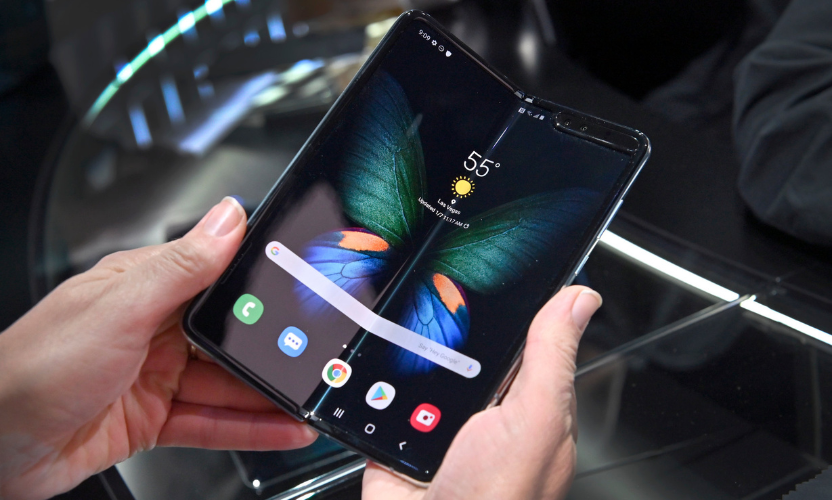
Why the Display Doesn’t Snap
Foldable phones use flexible OLED displays, not glass screens.
Traditional glass cracks when bent. Foldable phones use:
- Ultra-Thin Glass (UTG)
- Polymer protective layers
- Flexible substrate materials
The hinge controls the bending radius. If the radius is too tight, the display fails. So engineers design the hinge to maintain a safe curvature every time the device folds.
This combination of foldable display technology and hinge precision makes modern foldables possible.
Types of Foldable Phone Hinges
Not all foldable phones use the same design.
1️⃣ Gear-Based Hinge
Used in early foldables.
- Interlocking gears control motion
- More mechanical parts
- Slightly thicker design
Durable but bulkier.
2️⃣ Waterdrop Hinge
Used in newer models like Samsung Galaxy Z Fold and Oppo Find N.
- Allows screen to bend in a teardrop shape
- Reduces visible crease
- Closes fully with no gap
This is currently the most advanced foldable phone hinge mechanism.
3️⃣ Dual-Axis Hinge
Used in flip-style phones.
- Compact
- Designed for 180-degree folding
- Optimised for pocket-sized devices
Different folding style, same engineering challenge.
How Hinges Stay Durable
Manufacturers test hinges aggressively.
Typical durability tests include:
- 200,000 to 500,000 fold cycles
- Extreme temperature testing
- Dust resistance checks
- Drop tests
For example, Samsung claims some models survive over 200,000 folds. That equals:
Opening and closing your phone 100 times per day for 5+ years.
Without durability, foldables would be useless.
The Role of Dust Protection
One major early problem was dust entering the hinge.
Tiny particles could:
- Scratch internal parts
- Damage the display from underneath
- Cause stiffness in folding
Modern designs now include:
- Brush systems inside the hinge
- Sealed micro-chambers
- Reinforced housing
This drastically improves reliability.
If you’re following upcoming technology trends 2026, you’ll notice manufacturers are now focusing heavily on hinge sealing improvements.

How Foldable Phones Maintain Stability at Different Angles
Have you noticed some foldables can stay open at 90 degrees?
That’s intentional.
The hinge includes:
- Friction-based resistance
- Tension control systems
- Position-lock engineering
This allows “Flex Mode” in some devices — useful for video calls or hands-free photography.
This type of engineering is also influenced by artificial intelligence in mobile apps, where software adapts the UI depending on the fold angle.
Hardware and software now work together.
The Engineering Challenges Behind the Hinge
Here’s the hard truth: foldable hinges are extremely difficult to design.
Engineers must balance:
- Thinness
- Strength
- Smooth motion
- Weight
- Manufacturing cost
More parts = more failure points.
Fewer parts = more stress per component.
That’s why premium foldables are expensive. The hinge system alone is far more complex than a traditional smartphone frame.
Why the Crease Still Exists
Even with waterdrop hinge systems, the crease doesn’t disappear completely.
Why?
Because any material that bends repeatedly develops stress patterns. The hinge reduces tension but cannot eliminate it entirely.
Future improvements will likely focus on:
- Stronger ultra-thin glass
- New polymer blends
- Advanced hinge geometry
This is part of the broader shift toward flexible hardware innovation.
Are Foldable Hinges the Future?
Right now, foldables are still a premium niche product.
But hinge technology keeps improving yearly.
As manufacturing costs decrease and durability increases, foldable phones could become mainstream.
If you understand mobile-first indexing, you already know screen size flexibility affects how people consume content. Foldables sit between smartphones and tablets potentially changing digital behaviour.
The hinge is what makes that possible.