When comparing Custom vs Template Websites, many businesses struggle to decide which option truly delivers better ROI. While template websites offer affordability and speed, custom development provides scalability, flexibility, and long-term growth potential. Understanding the real differences between custom vs template websites is essential before making a strategic investment decision.
Some businesses prefer template-based platforms because they are affordable and quick to launch. Others invest in custom web development to gain full control, better performance, and long-term scalability. But which option truly delivers better ROI?
To answer that properly, we need to look beyond surface-level comparisons and examine cost structure, performance, SEO impact, scalability, security, and conversion potential.
Understanding Custom Web Development
Custom web development means building a website from the ground up. Every design element, feature, and line of code is created specifically for your business requirements.
Instead of adapting your business to fit a template, custom development shapes the website around your brand, workflow, and customer journey.
How Custom Websites Are Built
A typical custom development process includes:
- Discovery and planning
- Wireframing and UX strategy
- Custom UI design
- Frontend and backend development
- Database architecture
- Testing and optimisation
- Deployment and ongoing maintenance
Because everything is purpose-built, the final product is structured for performance, flexibility, and scalability.
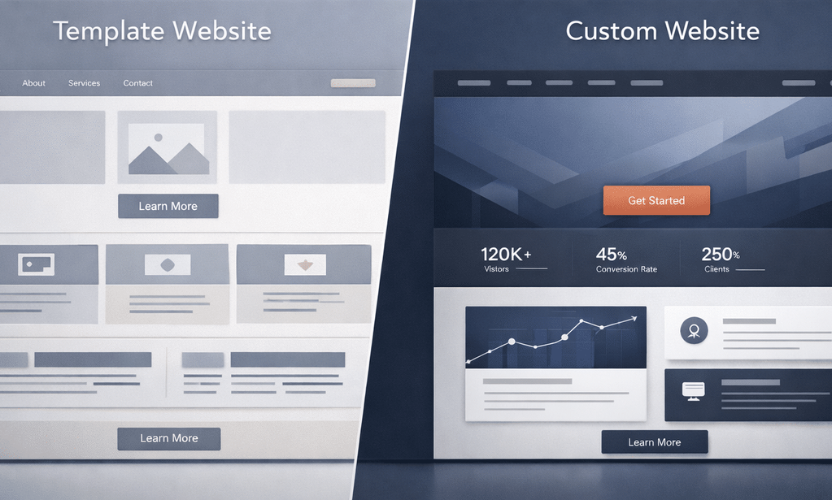
Core Advantages of Custom Development
Custom websites provide:
- Tailored functionality aligned with business goals
- Optimised code for better performance
- Full technical SEO control
- Flexible integrations with CRM, ERP, or third-party tools
- Scalable architecture for future growth
This approach requires a higher upfront investment, but it often reduces limitations in the long run.
Understanding Template-Based Website Solutions
Template solutions use pre-designed layouts and structures available through platforms such as WordPress, Shopify, Wix, and Squarespace.
Instead of building from scratch, businesses select a theme and customise colours, fonts, content, and layout within predefined boundaries.
How Templates Work
Templates come with built-in functionality and design elements. Many platforms support plugins or extensions that add features like contact forms, eCommerce functionality, SEO tools, and analytics tracking.
Modern templates are responsive, visually appealing, and easier than ever to deploy.
Advantages of Template Websites
Template-based websites are popular because they offer:
- Lower upfront cost
- Faster launch time
- Simpler management for non-technical users
- Pre-built integrations
For startups and small businesses with limited budgets, templates can be a practical entry point. However, ROI is not only about initial affordability. It’s about long-term performance and growth potential.
Custom vs Template Websites: Key Differences
To understand which option delivers better ROI, it helps to compare them across critical factors.
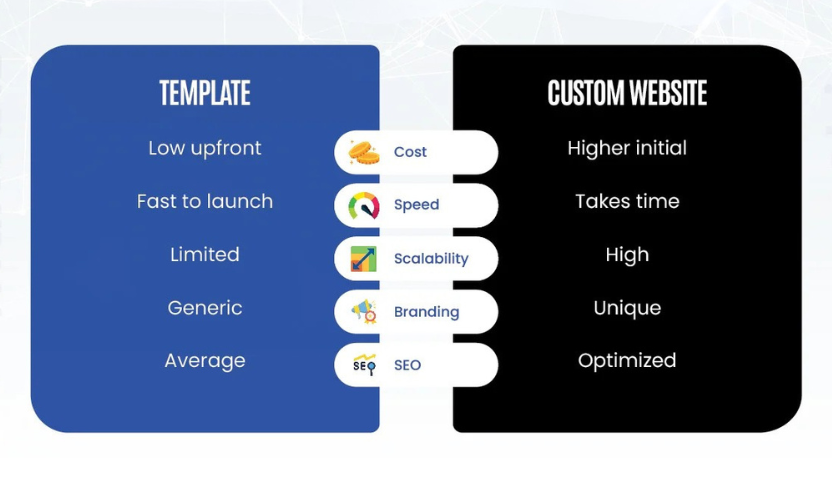
| Factor | Custom Web Development | Template Solutions |
| Initial Cost | Higher upfront investment | Lower entry cost |
| Performance | Optimised, lean code | May include unused code |
| SEO Flexibility | Full technical control | Platform limitations |
| Scalability | Built for growth | Can face structural limits |
| Customisation | Unlimited | Restricted by theme |
| Maintenance | Controlled updates | Platform & plugin dependency |
| Long-Term ROI | Strong for scaling businesses | Moderate for smaller sites |
The biggest difference lies in long-term flexibility. Templates prioritise speed and affordability, while custom development focuses on strategic growth.
Cost Breakdown: Short-Term vs Long-Term Investment
Many businesses make decisions based only on setup cost. However, a true ROI analysis must consider the total cost of ownership over several years.
Custom Web Development Cost Structure
Custom development typically includes:
- Planning and strategy
- Design and UX research
- Development and testing
- Deployment
- Ongoing maintenance
While the upfront cost may range significantly depending on complexity, long-term redesigns are often less frequent because the architecture is adaptable.
Template Website Cost Structure
Template websites often involve:
- Theme purchase or subscription
- Monthly platform fees
- Premium plugins
- Hosting
- Paid integrations
- Periodic redesign or migration
What appears affordable initially can accumulate over time. Plugin renewals, performance fixes, and structural limitations can increase costs as the business grows.
Total Cost of Ownership (Example Perspective)
A template website may cost less in year one, but if growth requires redesign, platform migration, or additional plugins in years two or three, overall expenditure can rise significantly.
Custom development spreads investment differently, higher at the start, but potentially lower adjustment costs later. ROI depends on how long you plan to scale and how complex your digital strategy is.
SEO and Google Ranking Considerations
Search engine visibility plays a major role in ROI. A website that ranks well generates organic traffic without ongoing ad spend.
SEO Benefits of Custom Development
Custom websites can be built with:
- Clean, semantic HTML structure
- Optimised URL architecture
- Controlled metadata implementation
- Advanced schema markup
- Optimised Core Web Vitals (LCP, CLS, INP)
- Faster loading speeds
Because developers control every element, technical SEO can be integrated from the foundation.
Template SEO Limitations
Modern templates include SEO tools, but limitations may arise due to:
- Code bloat from unused features
- Plugin conflicts
- Restricted URL structure
- Shared hosting performance issues
While templates can rank well, advanced optimisation may be constrained by platform restrictions. For businesses relying heavily on organic traffic, custom web development often provides greater long-term SEO flexibility.
Performance and Core Web Vitals Impact
Website performance directly affects both rankings and conversions.
Custom development allows:
- Lightweight code
- Custom caching strategies
- Database efficiency
- Reduced server load
- Improved Core Web Vitals
Templates may include additional scripts and design elements that impact load times, particularly when multiple plugins are installed.
Faster websites generally experience:
- Lower bounce rates
- Higher engagement
- Improved conversion rates
Performance optimisation contributes directly to ROI because speed influences user behaviour.
Conversion Rates and Revenue Impact
ROI is ultimately tied to revenue growth.
Custom websites allow:
- Personalised user journeys
- Tailored landing page structures
- Flexible call-to-action placement
- Advanced A/B testing
- Custom checkout flows
Template solutions offer standard layouts, which may limit conversion optimisation strategies.
If your website is central to lead generation or eCommerce sales, conversion flexibility becomes a significant ROI driver. Even small improvements in conversion rates can justify higher initial investment.
Scalability and Business Growth
Scalability determines how easily your website adapts as traffic and complexity increase.
Custom web development supports:
- Modular architecture
- Custom API integrations
- CRM and ERP connectivity
- Expansion of features without rebuilding
Templates can handle moderate growth but may struggle with complex integrations or high traffic volumes. Businesses planning long-term expansion often benefit from a scalable custom framework.
Security and Maintenance Considerations
Security risks can impact financial stability and brand reputation.
Custom websites allow tailored security measures, controlled update schedules, and industry-specific compliance implementation.
Template platforms manage many updates automatically, which simplifies maintenance but may introduce shared vulnerabilities across multiple sites using the same theme.
Security incidents carry hidden ROI costs, including downtime and reputation damage.
When Should You Choose Custom Web Development?
Custom development makes sense if:
- Your business model requires unique functionality
- You expect rapid growth
- SEO is a primary acquisition channel
- You need complex integrations
- Your website drives significant revenue
For companies treating their website as a strategic asset, custom development often delivers stronger long-term ROI.
When Does a Template Solution Make More Sense?
Templates may be suitable if:
- Budget is limited
- Time-to-market is urgent
- Functionality requirements are standard
- The website serves as a simple informational presence
For small businesses validating an idea, template solutions provide a practical starting point.
Frequently Asked Questions
Is custom web development worth the higher cost?
It depends on business goals. If long-term scalability, SEO control, and conversion optimisation are priorities, custom development often justifies the investment.
Are template websites bad for SEO?
Not necessarily. Many template websites rank well. However, technical SEO flexibility can be more limited compared to custom-built solutions.
Which delivers better ROI in the long term?
For growing businesses with complex needs, custom development typically provides better long-term ROI. For smaller operations, templates can deliver faster short-term returns.
Can a template website scale with business growth?
To a degree, yes. But structural and platform limitations may require migration as complexity increases.
How long does custom web development take?
Depending on complexity, development may take several weeks to several months. The timeline reflects the level of planning and customisation involved.
Is WordPress considered a template solution?
WordPress can function as both. It can use pre-built templates or be developed with fully custom themes and functionality.
Final Thoughts: Which One Truly Delivers Better ROI?
The debate around custom web development vs template solutions is not about which option is universally better. It is about alignment with business objectives.
Template websites offer affordability and speed. They work well for straightforward projects and early-stage businesses.
Custom web development requires greater investment but provides deeper flexibility, stronger performance optimisation, enhanced SEO control, and scalable architecture.
If your website is central to revenue, marketing, and brand positioning, custom development often produces stronger long-term returns. If your needs are simple and budget-driven, template solutions can still deliver practical value.
Ultimately, ROI is not defined by cost alone; it is defined by how effectively your website supports sustainable growth.