AI Laptops 2026: How Windows PCs Are Becoming Smarter
 By Inflix
 AI laptops 2026 could become one of the biggest computer trends of the year. Windows PCs are no longer only about faster processors, bigger screens and better battery life. They are now becoming smarter machines that can run AI tasks, support personal agents, improve creative workflows and help users work faster.
This shift matters because AI is moving from cloud tools into everyday devices. Instead of opening a web browser every time users need AI help, new laptops may handle more tasks locally.
For Mobile Verse readers, this topic is important because laptops are becoming more like intelligent assistants. The future PC may not only wait for commands. It may help organise work, edit content, summarise files and complete tasks across apps.
What Are AI Laptops 2026?
AI laptops 2026 are Windows PCs built with hardware and software designed for artificial intelligence tasks. These laptops may include NPUs, powerful GPUs, AI-ready processors, Copilot+ features and support for local AI models.
The main idea is simple. A normal laptop runs apps. An AI laptop can also run smarter features such as summaries, image editing, translation, search, writing help and personal assistant tools.
For official details, Microsoft explains how Copilot+ PCs bring AI-powered Windows experiences for business users, productivity and modern workflows.
Why AI Laptops 2026 Matter
AI laptops 2026 matter because people now use AI for daily tasks. Students use AI for research. Creators use AI for images and video. Developers use AI for coding. Office workers use AI for emails, meetings and documents.
Until recently, many of these tools depended heavily on cloud servers. That can create delays, privacy concerns and internet dependency.
Smarter laptops can reduce that problem by running more AI tasks directly on the device.
Windows PCs Are Entering a New AI Era
Windows PCs are entering a new AI era because Microsoft, Nvidia, Qualcomm, Intel and AMD are all pushing AI-ready hardware. This is not a small feature update. It is a major change in how laptops may work.
Instead of treating AI as a separate app, Windows is moving toward deeper AI integration.
That means future laptops could understand files, help with tasks, support personal agents and work more intelligently across apps.
Copilot+ PCs Are the First Big Step
Copilot+ PCs are Microsoft’s main AI laptop category. These machines are designed to run AI features more efficiently with dedicated neural processing hardware.
Copilot+ PCs can support smarter Windows features, better productivity tools and more local AI processing.
This matters because Microsoft wants AI to become part of the Windows experience, not only a chatbot inside a browser.
Nvidia AI PCs Add More Power
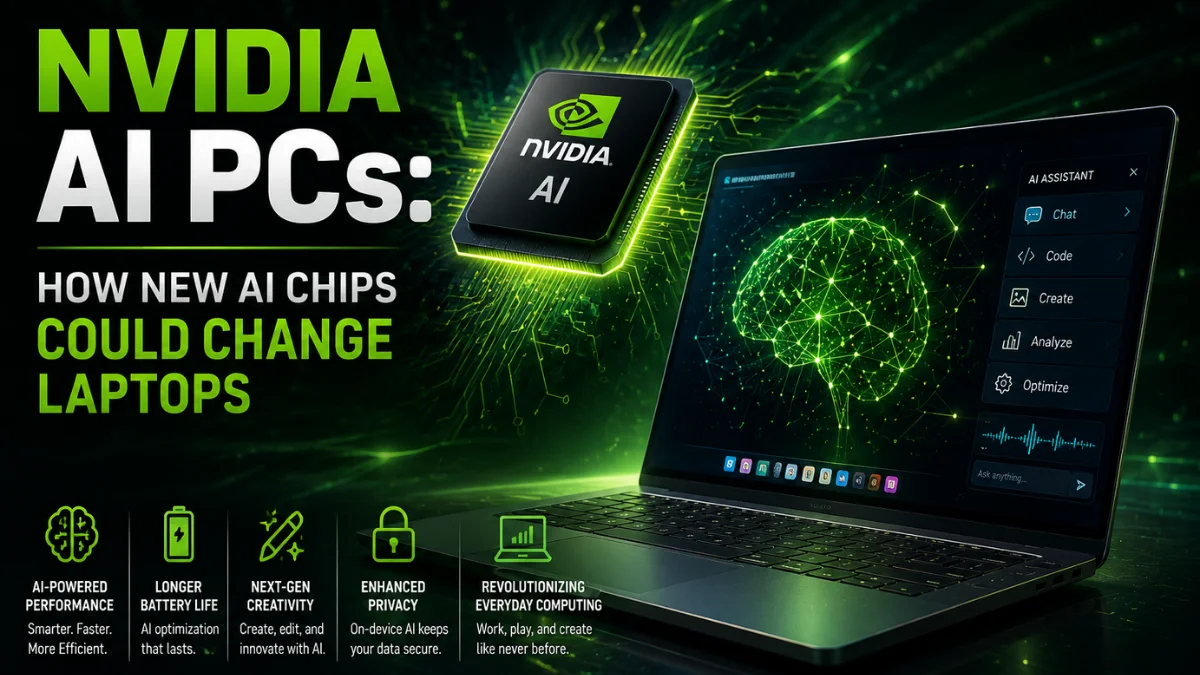
Nvidia AI PCs take the idea further by adding stronger RTX graphics and local AI performance. Nvidia’s RTX Spark platform is designed for Windows PCs built around personal AI agents, creative work, gaming and development.
This could make future laptops more powerful for people who work with AI models, video editing, 3D design, coding and advanced creative tools.
You can read our Mobile Verse post on Nvidia AI PCs to see how RTX Spark could change future Windows computers.
Personal AI Agents Could Change Laptops
Personal AI agents are one of the most exciting parts of AI laptops 2026. A personal agent is not just a chatbot. It can help users complete tasks, organise information and work across apps.
For example, an AI agent may summarise documents, prepare notes, search files, help write emails or assist with coding.
This could make laptops feel more active and helpful instead of passive machines.

Local AI Could Improve Privacy
Local AI could improve privacy because more tasks can run on the laptop instead of being sent to cloud servers. This is useful for personal files, work documents, private notes and business data.
A laptop that can process information locally may give users more control over sensitive content.
However, privacy still depends on apps, settings and company policies. Hardware alone does not guarantee perfect privacy.
Faster AI Features Without Cloud Delays
AI laptops can also feel faster because local processing reduces cloud delays. If the device can handle tasks directly, users may get quicker summaries, edits, translations and search results.
This matters for people who use AI many times a day.
A faster AI experience can make the laptop feel more useful during work, study and creative projects.
AI Laptops 2026 for Students
AI laptops 2026 could be useful for students because they can help with research, summaries, revision notes, presentations and coding practice.
Students may use AI to organise study material, explain complex topics and turn rough notes into cleaner drafts.
However, schools and universities will need clear rules. AI should support learning, not replace original work.
AI Laptops 2026 for Creators
Creators may benefit strongly from AI laptops. Video editors, designers, photographers and content creators already use demanding tools.
AI can help remove objects, upscale images, generate captions, clean audio, edit video and organise media libraries.
With stronger local AI hardware, these tasks could become faster and more reliable.
AI Laptops 2026 for Developers
Developers could also benefit because AI laptops can support coding assistants, local models, debugging help and app testing.
Instead of relying only on cloud services, developers may run smaller AI models on their own devices.
This could help reduce costs, improve privacy and make experimentation easier.
AI Laptops 2026 for Business Users
Business users may use AI laptops for meeting summaries, email drafts, document search, spreadsheets, presentations and internal knowledge tools.
This could save time during normal office work.
Microsoft is especially focused on business use because many companies already depend on Windows laptops.
NPUs Are Becoming Important
NPUs, or neural processing units, are becoming important because they handle AI tasks efficiently. A CPU can run general tasks, and a GPU can handle graphics and heavy workloads, but an NPU focuses on AI processing with better power efficiency.
This matters for battery life. A laptop should run AI features without draining power too quickly.
That is why AI laptop makers are talking more about NPUs in 2026.
GPUs Still Matter for AI Laptops
GPUs still matter because many advanced AI tasks need strong parallel processing. Nvidia has an advantage here because its RTX graphics technology already powers gaming, creative work and AI acceleration.
For users who need local model work, video editing or 3D design, GPU power can be very important.
This is why Nvidia’s role in AI laptops could become bigger in 2026.
AI Laptops vs Normal Laptops
AI laptops differ from normal laptops because they are built for local AI tasks. A normal laptop may run basic software well, but it may struggle with advanced AI workflows.
An AI laptop can handle smarter features more efficiently.
However, normal laptops are still fine for simple browsing, email, streaming and office work. Not everyone needs an AI PC immediately.
AI Laptops vs AI PCs
AI laptops are portable computers, while AI PCs can include desktops, workstations and compact systems. Laptops focus on mobility and battery life. AI desktops can offer more power and cooling.
This means creators, gamers and developers may choose different devices depending on workload.
A student may prefer an AI laptop, while a studio may prefer a powerful AI workstation.
Could AI Laptops Replace Cloud AI?
AI laptops will not fully replace cloud AI. Large models and heavy enterprise workloads will still need data centres.
However, laptops can handle smaller tasks locally. This can reduce cloud dependency and make daily AI features faster.
The future will likely use both local AI and cloud AI together.
What Features Could AI Laptops Bring?
AI laptops could bring many useful features. These may include smarter search, live captions, translation, image editing, document summaries, meeting notes, coding help and personal assistants.
Some features may work offline or partly offline if the device has enough local AI power.
This is where AI laptops become more useful than normal machines.
Windows 11 and the AI PC Future
Windows 11 is becoming more AI-focused as Microsoft adds Copilot features and prepares for more agent-style workflows.
The operating system may become better at helping users find files, manage tasks and interact with apps through natural language.
This could make Windows feel more modern and more competitive against Apple’s ecosystem.
AI Laptops and Battery Life
Battery life will be a major challenge. AI workloads can be demanding, and users will not accept laptops that become hot or drain quickly.
That is why efficient chips, NPUs and smart workload scheduling matter.
The best AI laptops will need to balance performance with all-day battery life.
AI Laptops and Gaming
Some AI laptops may also be strong gaming machines, especially those using Nvidia RTX hardware. Gaming laptops already use powerful GPUs, so adding AI features makes sense.
AI can also improve gaming through upscaling, frame generation and performance optimisation.
This creates a useful overlap between AI laptops and gaming laptops.

AI Laptops and Creative Tools
Creative tools may become one of the biggest reasons to buy AI laptops. Apps for photo editing, video editing, music, design and 3D work are adding more AI features.
A stronger AI laptop could make these features faster and smoother.
This can help creators work locally without always depending on online AI services.
Should You Buy an AI Laptop in 2026?
You should consider an AI laptop in 2026 if you use AI tools regularly, create content, code, study, work with documents or want a future-ready Windows PC.
However, if you only browse the web, watch videos and use basic office apps, a normal laptop may still be enough.
The best choice depends on your budget and how much you actually use AI.
What to Check Before Buying
Before buying an AI laptop, check the processor, NPU performance, GPU, RAM, storage, battery life and display quality.
Also check which AI features are actually supported. Some laptops may use AI branding but offer limited real-world benefits.
Buyers should wait for reviews before spending more on premium AI models.
What This Means for Future Computers
AI laptops 2026 show where computers are heading. The PC is changing from a passive machine into a smarter assistant that can help with work, creativity and daily tasks.
This shift will take time, but the direction is clear.
Future laptops may understand user context, manage workflows and help complete tasks faster than today’s computers.
Final Thoughts
AI laptops 2026 could change how people use Windows PCs. With Copilot+ features, Nvidia AI hardware, personal agents and local AI processing, laptops are becoming smarter and more useful.
The biggest benefits may include faster workflows, better privacy, stronger creative tools and more helpful personal assistants.
Overall, AI laptops are not just another marketing trend. They could become a major step toward computers that actively help users get work done.
FAQs
What are AI laptops 2026?
AI laptops 2026 are Windows PCs designed with AI-ready hardware and software for local AI tasks, Copilot features and smarter workflows.
Are AI laptops better than normal laptops?
AI laptops are better for users who need AI tools, creative features, coding help and local processing. Normal laptops are still fine for basic tasks.
What is a Copilot+ PC?
A Copilot+ PC is a Windows computer built to run AI features more efficiently using dedicated AI hardware such as an NPU.
Do AI laptops need the internet?
Some AI features may work locally, but many tools still use cloud support. The best experience will likely combine local and online AI.
Are AI laptops good for gaming?
Some AI laptops can be good for gaming, especially models with Nvidia RTX graphics and gaming-focused hardware.
Should I buy an AI laptop in 2026?
You should buy one if you use AI tools often or want a future-ready laptop. Basic users may not need to upgrade immediately.