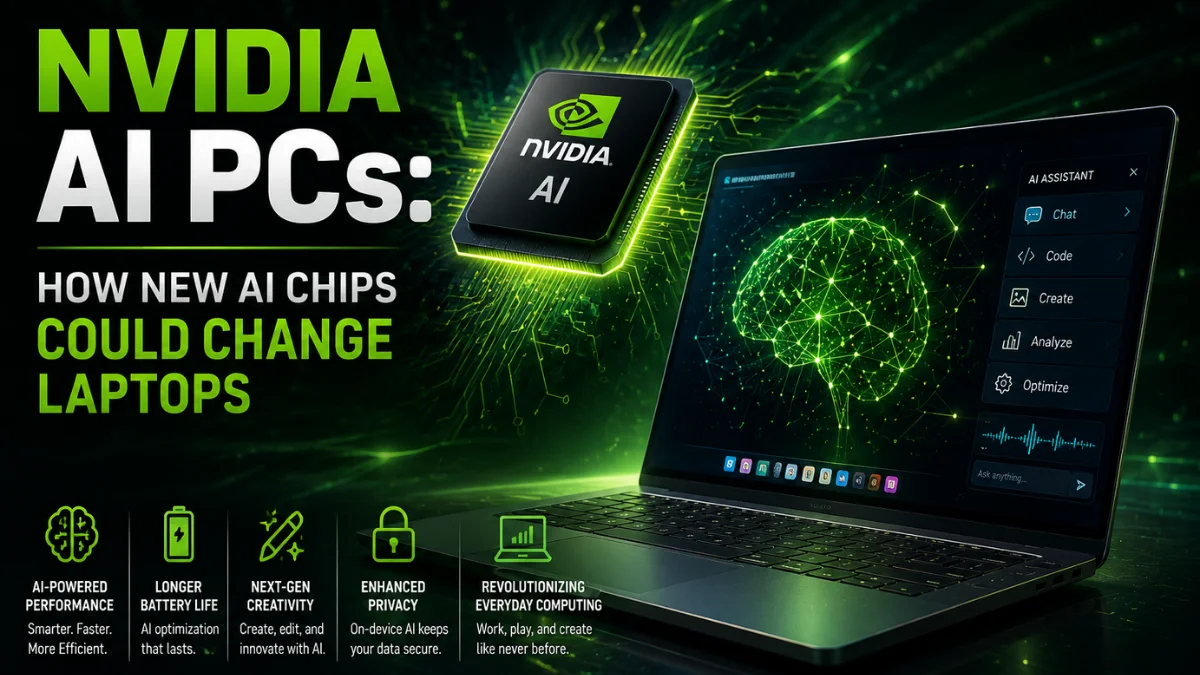
Nvidia AI PCs: How New AI Chips Could Change Laptops
 By Inflix
 Nvidia AI PCs could become one of the biggest computer trends of 2026. After dominating AI data centres, Nvidia is now pushing deeper into personal computers with a new chip designed for Windows laptops, compact desktops, creators, gamers and personal AI agents.
The headline product is Nvidia RTX Spark, a new superchip created with Microsoft for the next generation of Windows PCs. Instead of relying only on cloud AI, these new computers aim to run more AI tasks directly on the device.
This matters because laptops are changing. In the past, users mostly judged a laptop by processor speed, battery life, screen quality and storage. Now, AI performance is becoming just as important.
What Are Nvidia AI PCs?
Nvidia AI PCs are Windows computers built to run advanced AI tasks locally with Nvidia’s RTX and AI hardware. These PCs are designed for personal AI agents, creative workflows, gaming, video editing, coding, local model use and smarter productivity tools.
The main idea is simple. Instead of sending every AI task to the cloud, future PCs may handle more work directly on the laptop or desktop.
For official details, Nvidia explains how RTX Spark and Microsoft Windows are designed for personal AI PCs, including AI agents, RTX graphics and Windows-native AI features.
Why Nvidia AI PCs Matter
Nvidia AI PCs matter because artificial intelligence is moving from data centres into everyday devices. Users already use AI tools for writing, images, video, coding, research, meetings and search.
However, many of these tools still depend heavily on cloud servers. That can create issues with speed, privacy, cost and internet dependency.
A powerful AI laptop could run more tasks locally. As a result, users may get faster responses, better privacy and more useful AI features even when they are not fully connected to the cloud.
RTX Spark Is the Big New Chip
RTX Spark is the chip behind Nvidia’s new AI PC push. Nvidia says the superchip combines AI performance, RTX graphics technology, CUDA support and strong memory capacity for Windows PCs.
This is important because Nvidia is not only targeting gaming laptops. The company wants AI PCs to support personal agents, creators, developers and professionals.
If RTX Spark works as promised, it could make Windows laptops much better for AI-heavy work.
Why RTX Spark Could Change Laptops
RTX Spark could change laptops because it brings powerful AI processing closer to normal users. Instead of needing a large workstation or cloud service, users may run more advanced AI tools on a slim laptop.
This could help people who edit videos, generate images, build apps, analyse data or use AI assistants throughout the day.
For creators and professionals, that could mean faster workflows and less waiting.
Personal AI Agents on Windows PCs
One of the most important ideas behind Nvidia AI PCs is the personal AI agent. A personal agent is more than a chatbot. It can understand tasks, open tools, manage workflows and help users complete work across apps.
For example, a laptop AI agent may help summarise files, prepare slides, edit images, organise emails, write code or search through personal documents.
This is where Nvidia and Microsoft see the future of PCs. The computer may move from being a tool you control manually to a smarter assistant that helps you finish tasks.
Microsoft’s Role in the AI PC Push
Microsoft is important because these chips are built for Windows PCs. Windows already powers many laptops and desktops used by businesses, students, creators and gamers.
If Microsoft integrates AI agents deeply into Windows, RTX Spark laptops could become more useful than normal AI-ready devices.
This could also help Windows compete more strongly with Apple’s Mac ecosystem, especially as Apple adds more Apple Intelligence features across its own devices.

Nvidia AI PCs vs Traditional Laptops
Traditional laptops usually focus on CPU power, graphics, RAM, storage and battery life. Nvidia AI PCs add another layer: local AI performance.
That means buyers may soon compare laptops by how well they run AI models, creative tools and intelligent assistants.
This does not mean normal laptop specs no longer matter. Battery life, display quality and build quality still matter. However, AI performance could become a major buying reason.
On-Device AI Could Improve Privacy
On-device AI could improve privacy because more tasks can run locally. If a laptop can process personal files, notes, images and documents on the device, users may not need to send everything to external servers.
This is important for businesses, students, creators and anyone working with private data.
However, privacy will still depend on how apps are built. A powerful chip alone does not guarantee safe data handling.
Faster AI Workflows for Creators
Nvidia AI PCs could be very useful for creators. Video editors, designers, photographers and 3D artists already use GPU power for demanding tasks.
With stronger AI chips, creative tools may become faster and smarter. Users could remove objects, generate backgrounds, enhance video, upscale images or edit content with AI assistance.
This is where Nvidia’s RTX ecosystem could give it an advantage because many creative tools already support GPU acceleration.
Better Gaming and AI Together
Nvidia is also known for gaming, so RTX Spark could bring benefits beyond AI. RTX graphics, DLSS, Reflex and G-SYNC support could make these laptops useful for gamers too.
This combination matters because many buyers want one laptop for work, gaming and creative projects.
If Nvidia can deliver strong AI performance and strong gaming performance in the same device, it could create a new premium laptop category.
Why Developers Should Care
Developers should care because local AI tools can make coding faster and more private. A powerful AI PC could help with code generation, debugging, app testing and local model experimentation.
Instead of relying only on cloud APIs, developers may run smaller or specialised models directly on their machines.
This could reduce costs and make experimentation easier.
Up to 128GB Unified Memory
Nvidia says RTX Spark supports up to 128GB of unified memory. That is important because AI models often need large memory capacity to run smoothly.
More memory can help with larger local models, creative projects and heavy multitasking.
This does not mean every laptop will include 128GB memory. However, the platform shows that Nvidia is targeting serious AI workloads, not only basic assistant features.
1 Petaflop AI Performance
Nvidia says RTX Spark can deliver 1 petaflop of AI performance. This sounds technical, but the simple meaning is that the chip is built for very demanding AI tasks.
For normal users, the result could be faster AI responses, better creative tools and smoother local processing.
For professionals, it could help with local AI model testing, content production and advanced workflows.
Could Nvidia Challenge Intel, AMD and Qualcomm?
Nvidia AI PCs could create new competition in the laptop chip market. Intel and AMD have long dominated Windows laptops, while Qualcomm is pushing Windows on Arm with Snapdragon chips.
Nvidia now wants a bigger role in personal computers, not only gaming GPUs and data-centre AI chips.
If RTX Spark performs well, laptop makers may have a new high-performance AI option for premium Windows machines.
Nvidia AI PCs vs Apple Silicon
Apple Silicon has been successful because it combines strong performance, battery efficiency and tight hardware-software integration. Nvidia and Microsoft now appear to be building a stronger Windows answer.
Nvidia may compete through GPU power, AI performance, RTX tools and developer support. Apple may still lead in battery efficiency and ecosystem control.
This could become one of the biggest laptop battles of 2026.
Why AI PCs Could Help Businesses
Businesses may benefit from Nvidia AI PCs because many companies want AI tools but also care about data control. Local AI processing could help teams work with sensitive documents, internal data and private workflows.
AI PCs could support meeting summaries, document search, data analysis, coding, design and customer support tools.
However, businesses will still need strong security policies before using AI with sensitive information.
What This Means for Students
Students may also benefit from AI PCs. A smarter laptop could help with research, note summaries, revision plans, coding practice, presentations and creative projects.
However, schools and universities will need clear rules around responsible AI use.
The best use of AI in education should support learning, not replace original thinking.
What This Means for Everyday Users
For everyday users, Nvidia AI PCs could make laptops feel more helpful. The computer may help organise files, summarise documents, edit photos, write emails or search personal content faster.
This could save time during normal work.
However, the real value will depend on apps. If software developers build useful AI tools, these laptops could feel very different from current PCs.

Will Nvidia AI PCs Be Expensive?
Early Nvidia AI PCs may be expensive because they target premium users, creators, gamers and professionals. New chip platforms usually start at higher prices before becoming more affordable.
However, if the technology becomes popular, cheaper versions may appear later.
Buyers should wait for real laptop pricing, reviews and battery tests before deciding.
Should You Wait for Nvidia AI PCs?
You should wait for Nvidia AI PCs if you are planning to buy a premium laptop for AI work, gaming, content creation or software development.
However, if you only need a laptop for browsing, emails and simple office work, you may not need this level of AI power yet.
The best decision depends on your workload, budget and how much you actually use AI tools.
What Nvidia Needs to Get Right
Nvidia needs to get performance, battery life, Windows integration and pricing right. A powerful AI chip will not be enough if laptops become too expensive, too hot or too power-hungry.
The company also needs strong support from laptop brands and software developers.
If Nvidia, Microsoft and PC makers deliver a smooth experience, RTX Spark could become a major turning point for Windows laptops.
How This Fits the Future of AI Devices
Nvidia AI PCs fit into a bigger trend where devices are becoming smarter and more local. Phones, laptops, smart glasses and wearables are all adding AI features.
The difference is that laptops have more power and larger screens, so they can handle heavier workflows.
You can also read our Mobile Verse guide on AI phones 2026 to see how smartphones are also becoming personal assistants.
Final Thoughts
Nvidia AI PCs could change how people think about laptops. Instead of buying a computer only for browsing, work and entertainment, users may soon buy laptops based on how well they handle AI agents and local intelligence.
RTX Spark gives Nvidia a serious way to enter the personal computer market with Microsoft. It also puts pressure on Intel, AMD, Qualcomm and Apple.
Overall, this could be one of the most important PC shifts of 2026 because the laptop may become less like a passive machine and more like an active AI teammate.
FAQs
What are Nvidia AI PCs?
Nvidia AI PCs are Windows laptops and desktops built with Nvidia AI chips, RTX graphics and local AI processing for smarter workflows.
What is RTX Spark?
RTX Spark is Nvidia’s new AI PC superchip designed for Windows computers, personal AI agents, creative work, gaming and local AI tasks.
How could Nvidia AI PCs change laptops?
They could make laptops faster for AI tasks, creative tools, coding, gaming and personal assistant features without relying only on cloud servers.
Are Nvidia AI PCs good for gaming?
Yes, they could be strong for gaming because Nvidia’s RTX technologies, DLSS, Reflex and G-SYNC support are part of the platform.
Will Nvidia AI PCs replace normal laptops?
Not immediately. They will likely start as premium laptops for creators, gamers, developers and AI-heavy users before becoming more common.
Should I wait for Nvidia AI PCs?
You should wait if you need a premium laptop for AI, gaming, content creation or development. Basic users may not need this much power yet.