AI tools replace jobs faster than most people expect. This is not a prediction anymore it is already happening across multiple industries. Companies are cutting costs, increasing efficiency, and replacing repetitive roles with automation.
If you still believe your job is safe, you are probably underestimating how fast AI is improving. Therefore, understanding which tools are leading this shift is critical.
In this article, we will break down five powerful AI tools that are already replacing jobs and explain what you should do next.
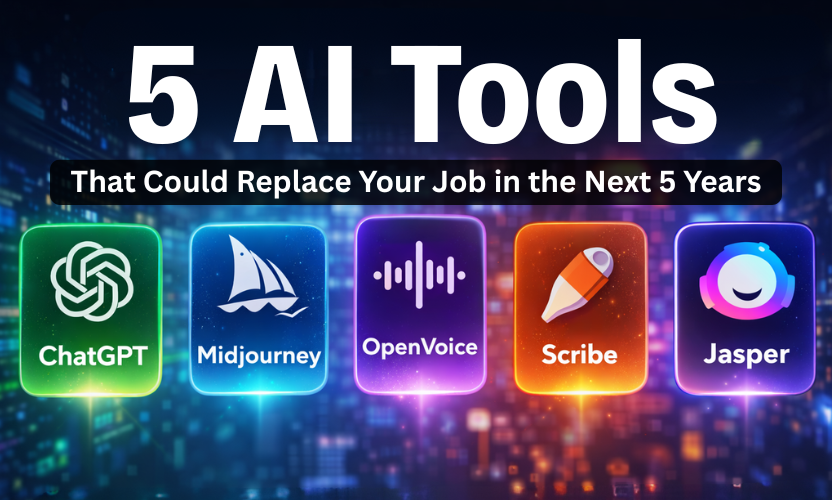
1. ChatGPT and AI Assistants: How AI Tools Replace Jobs
AI tools replace jobs most aggressively in content and communication roles, and ChatGPT is leading that shift.
It can write blog posts, emails, and reports, and even generate business ideas. In addition, it can handle customer queries and automate conversations at scale.
As a result, many companies are reducing their need for:
- Content writers
- Customer support agents
- Virtual assistants
However, the real issue is not just speed; it is consistency. AI delivers output instantly without fatigue.
If your job involves writing standard content or answering predictable questions, then AI can already replace you.
2. Midjourney and AI Image Generators: How AI Tools Replace Jobs
Another major way AI tools replace jobs is through design automation.
Tools like Midjourney and DALL·E allow users to create high-quality images in seconds. Instead of hiring a designer, companies now generate visuals using simple prompts.
Because of these changes, the following roles are at risk:
- Social media designers
- Logo creators
- Basic graphic designers
Moreover, these tools eliminate revision cycles. You can generate multiple design options instantly.
If you only possess basic skills in tools like Canva or simple Photoshop edits, you are directly competing with AI.
3. GitHub Copilot and AI Coding Tools: How AI Tools Replace Jobs
AI tools replace jobs even in technical fields like software development.
GitHub Copilot can code, fix errors, and suggest improvements in real time. Therefore, companies now require fewer junior developers.
This impacts:
- Entry-level programmers
- Code testers
- Debugging roles
Additionally, AI reduces development time significantly. A task that once took hours can now be completed in minutes.
If you rely solely on syntax knowledge and not problem-solving, then your role is already becoming outdated.
4. Synthesia and AI Video Creation
Video production is another area where AI tools replace jobs quickly.
Synthesia allows users to create professional videos using AI avatars and voiceovers. You do not need cameras, actors, or editing teams.
Because of these benefits, companies are replacing:
- Video editors (basic level)
- Training presenters
- Marketing video teams
Furthermore, content creation becomes faster and cheaper. Businesses prefer speed over traditional production quality.
If you limit your work to cutting clips and adding transitions, AI will easily outperform you.

5. AutoGPT and AI Automation Agents
This is where things become serious. AutoGPT does not just assist—it acts.
AI tools replace jobs at a deeper level with automation agents that can:
- Perform research
- Execute tasks
- Manage workflows
As a result, roles at risk include:
- Data entry operators
- Virtual assistants
- Operations managers
In addition, these systems can make decisions based on data. This reduces the need for human supervision.
If your job revolves around managing routine processes, then AI can replace you entirely.
You can explore more insights in our latest technology updates section, where we cover AI trends, smartphone innovations, and future tech developments shaping the industry.
What Jobs Are Most at Risk
AI tools replace jobs that follow predictable patterns. Therefore, the most vulnerable roles include:
- Repetitive digital work
- Low-level creative tasks
- Rule-based decision-making
On the other hand, jobs that require human judgement are safer.
What Jobs Will Survive
Not everything will disappear. However, the nature of work will change.
Jobs that will remain relevant:
- Strategic decision-making roles
- Creative problem-solving
- Leadership and communication roles
- Advanced technical expertise
Therefore, survival depends on your ability to adapt.
What You Should Do Now
Ignoring AI is not an option. If you do nothing, you will fall behind.
Instead, focus on these actions:
- Learn how to use AI tools effectively
- Shift from execution to strategy
- Develop critical thinking skills
- Build unique, non-repetitive expertise
This is not optional. It is necessary.
Final Thoughts
AI tools replace jobs faster than most people realise. However, the real threat is not AI itself.
The real threat is people who understand AI better than you.
If you stay average, you will be replaced. If you adapt, you will stay relevant.
For deeper insights into AI advancements, you can visit: https://openai.com